
Are you tired of having to drill holes in your walls to install new switches? Do you like to move your furniture around regularly but can’t because of fixed switches? The wireless switch is your solution. But what exactly is a wireless switch? What are its advantages? CD Engineering, expert in electricity, tells you all about it in this article.
The wireless switch has the same function as a conventional switch. It turns the light on and off.
It consists of two parts: the transmitter switch and the receiver microswitch.
The transmitter operates on 3Volt batteries. It can be placed in a flush-mounted box, on a surface, screwed to the wall or fixed with adhesive. So you can position it wherever you like in your room. Don’t forget about safety when making this choice.
The second, also known as a micromodule, is connected to the electrical wires of the luminaire in question. A word of advice: position the receiver switch at the same height as the cover so that it is not visible.
The transmitter switch controls the receiver microswitch by communicating via radio frequency. Wireless switches are often sold with two transmitter switches that can be placed anywhere in the room. Wireless control allows you to switch your lighting on and off from another room. Indeed, most wireless switches have a radio wave range of around ten metres. So you can install a switch in a room other than the one where the microswitch is located.
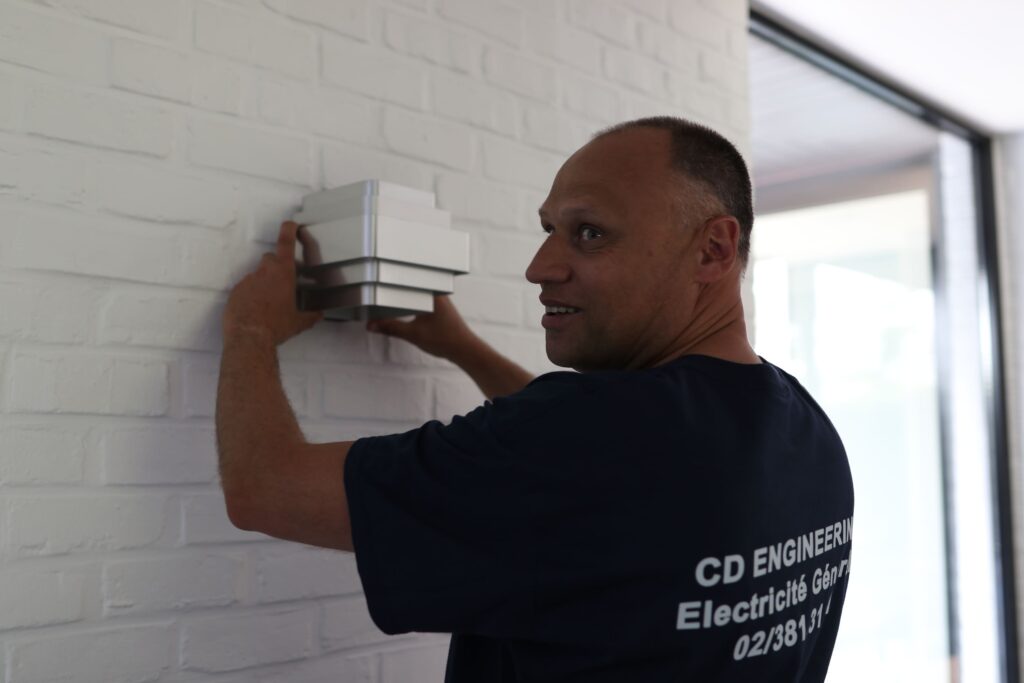
Why opt for a wireless switch? Well, it has a number of advantages compared to a conventional switch.
Firstly, and probably its biggest advantage, is that it can be placed wherever you want. If you decide to change the layout of a room, don’t worry, the electrical switch moves too. Likewise, if you’ve just moved in and you’re not happy with the way the switches are positioned, you can add new ones in the right places.
Secondly, it’s very easy to install. There’s no need for building work, electrical equipment or cutting into your walls. Some wireless switches can be screwed in place, while others can be fitted using adhesive tape. It’s up to you to choose which kit you prefer to buy.
And thirdly, there are also connected wireless switches. The wireless switch is already very practical, but the connected wireless switch is even more so. Indeed, it allows you to control your lighting remotely via a computer or via the application on your smartphone or tablet. It also helps you to check, via the app associated with your lighting, whether it is actually switched off. It can also be added to our home automation system and linked to the other connected devices in our home. In fact, if you’d like to install a home automation system in your home, CD Engineering can take care of it and offers many other services. You can now request a free quote on our website or by telephone on 02 381 31 01.
Some people have a DIY streak in them, others not at all. So if you’re one of the “not at all”, that’s not a problem. Installing and changing a switch is something you shouldn’t do without being informed. That’s why CD Engineering sends a certified electrician to your home to install your switches. Affordable prices and expert electricians, what more could you ask for? We do all kinds of electrical and lighting installations for you.
For more information, please contact us on 02 381 31 01.
A wireless switch works using radio waves and a receiver connected to your lighting circuit or to the electrical device you want to control, which gives much more flexibility of placement than a wired switch.
Installation starts by choosing where to put the switch (near a bed, at a room entrance or on a piece of furniture), then positioning the receiver close to the light fitting or appliance. This small unit is wired between the power supply and the equipment, usually in the existing wall box or in the ceiling rose.
Once everything is in place, pairing between the switch and receiver is carried out according to the manufacturer’s instructions, often by pressing both components at the same time, then checking operation with several on–off cycles. Some models allow you to link several switches to the same receiver, which is ideal when you want to control one light from different points in the room.
CD Engineering has solid experience installing these systems in Brussels and the surrounding area, and you can request a quote online at any time.
Installing a wireless switch is best entrusted to an electrician who is familiar with home automation technologies, since these devices are often integrated into wider connected ecosystems (smartphone control, synchronisation with other devices, time scheduling). The choice of communication protocol depends on your existing setup and on what you want to achieve.
Several criteria help you choose the right contractor: proven experience with both traditional and innovative systems, customer reviews confirming reliability and respect of deadlines, and a clear quote setting out all costs with no ambiguity.
CD Engineering combines traditional electrical expertise with connected-technology know‑how built over more than 30 years, and the team intervenes quickly in Brussels and its outskirts for both residential and professional premises.
How useful was this post?
Click on a star to rate it!
Average rating 0 / 5. Vote count: 0
No votes so far! Be the first to rate this post.