
When building a new home or simply updating an existing one, you may have several questions about lighting. Whether it’s recessed spotlights, LED or halogen lighting, there are plenty of choices for your bathroom. CD Engineering, expert in lighting in Brussels, gives you the best electrical equipment and interior lighting tips, including bathroom spotlights.
For design, elegance and practicality, you can opt for different types of luminaire. Technically speaking, you can choose any type, or even combine them. For example, you can totally place a ceiling light in the centre of the room and add a wall light. You can also add a LED spotlight above the sink or shower for an even more natural colour effect. Whatever your choice, you need to comply with current standards regarding the protection index, particularly in terms of waterproofing.
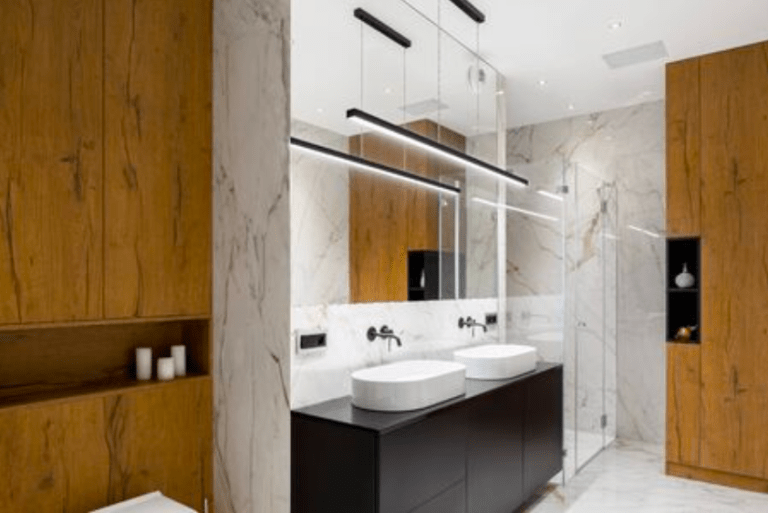
The IP rating is the minimum protection rating of the luminaire or spotlight you should have in your bathroom. Unlike a living room or a bedroom, a bathroom is much wetter. A too low lighting IP rating puts your entire electrical installation at risk.
The recommended minimum IP rating depends on the location of the lighting in the bathroom. Safety standards divide this room into 4 different volumes.
For this reason, in the shower or bath, volume 1 and volume 2, a minimum low-voltage IP of 44 is required. For volume 3 in the bathroom, you can opt for spotlights with a minimum IP23 rating.
Finally, volume 0 concerns lighting in the bath or shower, which must have a minimum IP67 rating.
If your electrical installations do not comply with the standard, you should consider upgrading them.
The power of a LED spotlight in a bathroom depends on several factors. Firstly, the brightness of the room, which depends in particular on whether or not there is a window. If you don’t have a window, you’ll be more likely to accentuate the lighting in the room to recreate a “daylight” effect. Generally speaking, spotlights used in bathrooms have a wattage of 4 to 6 watts. This wattage provides good lighting.
Finally, to optimise the light output as much as possible, we recommend that you multiply the light sources to create an even atmosphere in the room. In other words, don’t just install one high-power spotlight, but several with lower wattages. You can then define the colour temperature you want: warm white, cool white, etc.
Do you need an electrical installation or electrical renovation of your current installation? Don’t hesitate to call on CD Engineering’s qualified electricians! Contact us on 02 381 31 01 to request a quote.
Installing recessed spotlights in a bathroom follows a strict process and requires specific technical skills.
The first step is to cut a precise opening in the false ceiling, taking into account the diameter of the chosen spotlight and making sure there are no cables or pipes at that location. The electrical cables are then run from the junction box to each light point, leaving enough length to make the connections comfortably.
The wiring must comply with the standard colour codes for live, neutral and earth, depending on the model. Some LED spotlights have a built‑in transformer, while others require an external driver installed in the loft or above the ceiling.
The spotlight is then clipped into its housing using side springs that hold it in place. Before restoring the power supply, each light fitting is tested to ensure it works correctly.
CD Engineering uses equipment suitable for wet areas and carries out installations that comply with the RGIE, with quotes available online at any time.
The compliance of a bathroom spotlight is based on several criteria defined by the RGIE.
The first thing to check is the IP rating, a two‑digit code that indicates how well the fitting is protected: the first digit refers to protection against solid objects, the second to protection against water. Bathrooms are divided into zones according to their distance from water points: zone 0 (inside the bath) requires at least IP67, zone 1 (above the bath or shower) requires IP65, and zone 2 (the surrounding area) requires IP44; beyond these zones, IP21 is sufficient.
The electrical connection must also meet strict requirements. Each fitting must be supplied by a circuit protected by a 30 mA residual current device capable of detecting any leakage current. Low‑voltage spotlights require a transformer approved for use in damp environments, and any cables running in the false ceiling must have reinforced insulation suitable for the temperatures generated by the luminaires.
CD Engineering inspects lighting installations and identifies any potential non‑compliances.
How useful was this post?
Click on a star to rate it!
Average rating 0 / 5. Vote count: 0
No votes so far! Be the first to rate this post.